The off-grid reality guide
What building on the East Cape actually requires.
Power, water, wastewater, access, permitting, schedule and budget — the questions every owner should be able to answer before buying land here, not after.
Guide contents
What "off-grid" actually means here
Utility availability varies by property. An off-grid home operates independently of the electricity network and may also need its own water supply and wastewater systems. Road access must be assessed separately.
For both serviced and off-grid properties, infrastructure requirements should be coordinated early with the design and budget estimate. Installation is then sequenced to suit the construction program.
Power
A residential off-grid system has two jobs: generate enough energy on an average day, and store enough of it to cover the days that aren't average. Sizing starts from the house's actual load — HVAC is almost always the dominant draw on the East Cape, and a large house run at full air conditioning through August looks nothing like the same house in a mild December. A system sized to a spring day's usage will come up short every summer.
Storage exists to bridge the gap between when the sun is up and when the house is using power — evenings, early mornings, and the odd overcast or dusty day. More storage means fewer generator hours and a system that tolerates a bad week without drama; less storage means a smaller upfront bill and a generator that runs more often. That trade-off should be made deliberately, against the household's actual tolerance for a generator cycling on, not left to whatever the installer had in stock.
Backup power requirements depend on the home's energy needs, system design and the owner's expectations for reliability. Where a generator is included, fuel supply and maintenance should be planned from the outset.
Extending the CFE grid to a remote parcel is sometimes technically possible and almost never simple: it means a line-extension cost that scales with distance and terrain, an easement across every intervening property, and a timeline measured in CFE's queue, not the project's. For most East Cape lots, a well-designed off-grid system reaches occupancy faster and with fewer parties whose cooperation is required. Grid extension can make sense on a short, easy run near an existing line — it rarely makes sense as a default plan.
Water
Three sources cover almost every East Cape property: a private well, trucked water ("pipa") delivery, and, on a handful of larger or coastal developments, desalination. A well is the common answer inland, where the aquifer supports it — but well yield and quality vary block by block, not just town by town, so a producing well next door is not a guarantee for the lot in question. Test before committing a design to a well that hasn't been drilled and proven.
Trucked water works as a primary source for a smaller property or a secondary/backup supply for a larger one, but it depends on storage sized for the delivery interval — running out between trucks is a design failure, not a scheduling inconvenience. Storage sizing should account for the household's actual peak-season demand (again, summer occupancy with full irrigation and a pool draws far more than a quiet winter week), plus a margin for a missed or delayed delivery.
Whatever the source, water destined for drinking needs testing and treatment to potable standard — filtration and disinfection at minimum, sized to the source's actual water quality rather than a generic assumption. Irrigation and pool water can run on a lighter standard, but the two systems should be kept genuinely separate so a treatment failure on one doesn't compromise the other.
A proposed well requires assessment of water availability and quality, together with confirmation of applicable water rights and authorisations.
Wastewater
With no municipal sewer within reach, wastewater is handled on-site — most commonly a septic system, sized to the house's occupancy and fixture count, or a package treatment plant where the lot, soil, or a coastal setback makes a conventional septic field impractical. Coastal proximity matters here specifically: near the Sea of Cortez or an arroyo, both SEMARNAT and the municipality have a real interest in what leaves the property, and that interest shapes which system is permittable on a given parcel, not just which one is cheapest to install.
Treated wastewater reuse for irrigation is increasingly common on larger East Cape properties and can meaningfully reduce a well or trucked-water burden — but it is a second system to design, permit and maintain, not a footnote on the septic drawing. Whichever approach is chosen, plan for it at the same stage as the water source, since the two are functionally one water balance for the property, not two unrelated systems.
Access
A road that reads as fine in the dry season can become impassable in a single hurricane-season storm. Much of the East Cape's interior is cut by arroyos — dry for most of the year, and capable of running hard and fast during and after a tropical system. A driveway or access road that crosses one needs to be designed for that reality: proper drainage, a crossing built to survive water rather than fight it, and enough elevation above the arroyo bed that "impassable for a day" doesn't become "washed out for a season."
Road condition also drives the practical cost and schedule of everything that follows it — concrete trucks, equipment deliveries, and daily crew transport all depend on a road that survives the wet months, not just the dry ones. An access road built to a lower standard to save money early is one of the more common ways an East Cape project loses that savings later, in delayed deliveries and repeated repair.
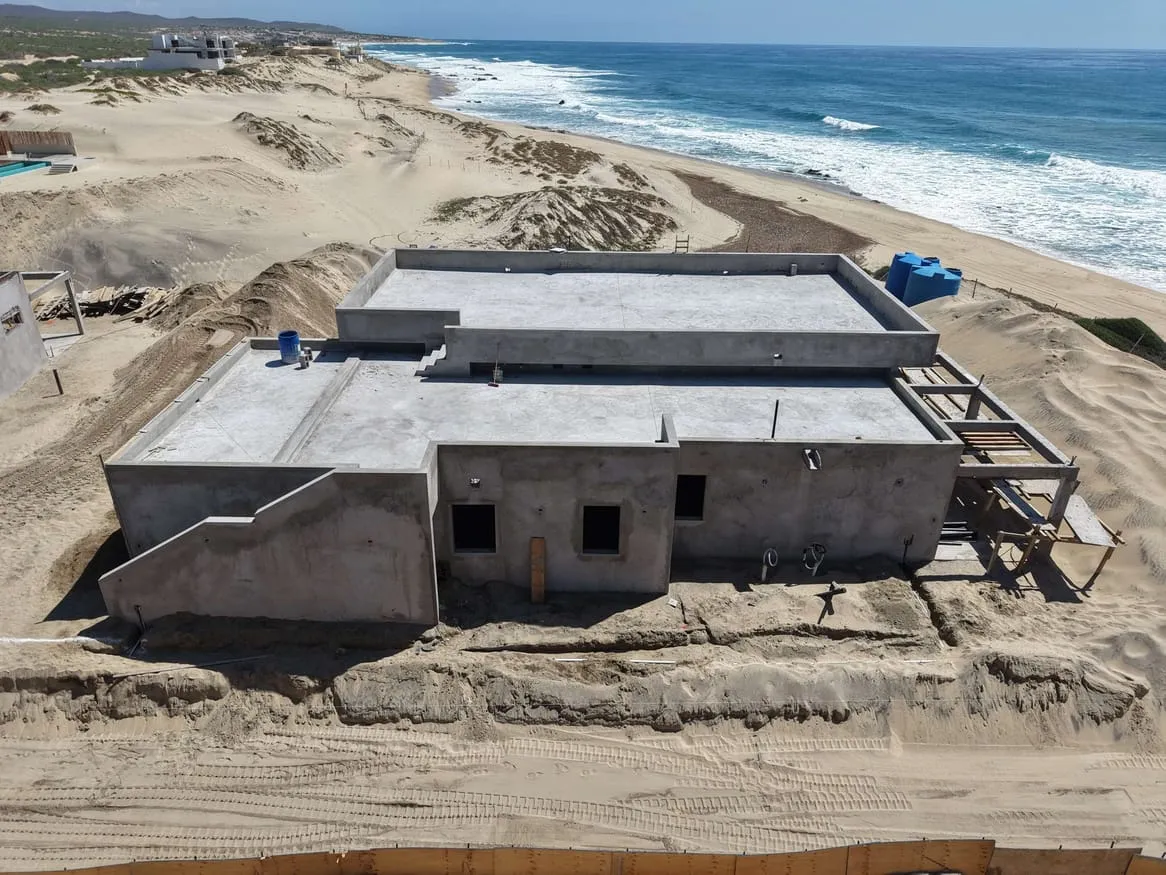
Work in progress in Bahía San Luis, East Cape.
Land and permitting
Land on the East Cape is held under a few distinct legal structures, and which one applies to a given parcel changes what can be built on it and how a foreign buyer can hold title. Private title (fee simple) is the most straightforward. Ejido land — communal agrarian land — requires its status to be resolved (typically converted to private title, dominio pleno) before it can be reliably developed or financed; building on unresolved ejido land is a common source of East Cape title disputes.
Foreign buyers within the restricted coastal and border zone (which covers essentially the entire East Cape) hold residential property through a fideicomiso — a bank trust that holds legal title for the foreign buyer's benefit — or through a Mexican corporation for certain uses. Which structure fits depends on the buyer's citizenship, intended use, and financing, and is a question for a notario and immigration/real-estate attorney, not a general guide.
Construction approvals depend on the property's location and characteristics. The relevant municipality and any additional authorities must be identified for each project.
None of the above should be read as a substitute for legal counsel. Land structure, permitting sequence and environmental review requirements are fact-specific to the parcel and change with regulation — this section describes the general landscape, not the legal status of any specific property.
Schedule and season
The Pacific hurricane season runs May 15–November 30, with the practical risk concentrated in August through October. That window doesn't stop construction outright, but it does shape the schedule: getting a building watertight — roof, envelope, drainage — before the season's peak is worth planning around, and an arroyo crossing or low-lying section of road is the first thing to lose if a storm does arrive mid-build.
Material logistics add their own lead time on top of the trade schedule. Much of what a high-end build specifies — certain fixtures, glazing, equipment, finish materials — routes through La Paz or Cabo San Lucas and, before that, through mainland or international suppliers, so lead times need to be built into the schedule months ahead of the fixture actually being needed on site, not ordered when the wall it hangs on is finished.
Labor and equipment mobilization is a real line item on a remote East Cape site in a way it usually isn't in a serviced subdivision closer to Cabo San Lucas or San José del Cabo — crew transport, temporary crew housing on more remote sites, and equipment that has to be brought in (and sometimes brought in again for a single specialized task) all belong in the schedule from day one.
Budget reality
The line items that make an East Cape budget look different from a serviced-lot budget are largely shaped by infrastructure and the logistics of building in a remote location:
- Mobilization — moving crews, equipment and materials to a site that may be an hour or more from the nearest supply yard, sometimes over a road that limits what size of truck can make the trip.
- Off-grid infrastructure needs to be planned and budgeted early, with installation coordinated around the construction sequence.
- Crew logistics — transport and, on the more remote sites, temporary housing, since a daily commute from San José del Cabo isn't always practical for a full crew.
- Lead time and freight — the further a fixture, system or finish has to travel, the more its price includes freight and the more its schedule depends on being ordered early.
None of this is a reason to avoid building here — it's a reason to have the full picture at the budgeting stage rather than the invoice stage. A cost model that treats infrastructure as a late add-on, instead of pricing it alongside the house from the first estimate, is the single most common source of an East Cape project running over its original number.
For how SDM coordinates these systems within a complete project, see our services.
Common questions
Frequently asked questions
Can I extend the CFE grid to my lot instead of going off-grid?
Sometimes, on a short run near an existing line — but grid extension usually means a distance-based cost, an easement across every property in between, and a timeline set by CFE's own queue rather than the project's. For most East Cape parcels, a well-designed off-grid power system is the faster and more predictable path to occupancy.
Do I need a fideicomiso to buy near the coast as a foreign buyer?
Foreign buyers within Mexico's restricted coastal zone — which covers the East Cape — typically hold residential property through a bank trust (fideicomiso) or, for certain uses, a Mexican corporation. Which structure applies depends on citizenship, intended use and financing; confirm with a notario and attorney before relying on this as legal guidance.
Does hurricane season stop construction?
Not outright, but it reshapes the schedule. Getting the building watertight before the season's August–October peak, and protecting any arroyo crossing or low-lying road section, are the priorities that schedule should be built around.
Why does an off-grid build cost more than a serviced-lot build?
An off-grid property may require independent power, water and wastewater systems, together with additional access and site logistics. These requirements need to be planned and budgeted early, with installation coordinated around the construction sequence.
Considering a lot on the East Cape
Talk through your site before you buy it.